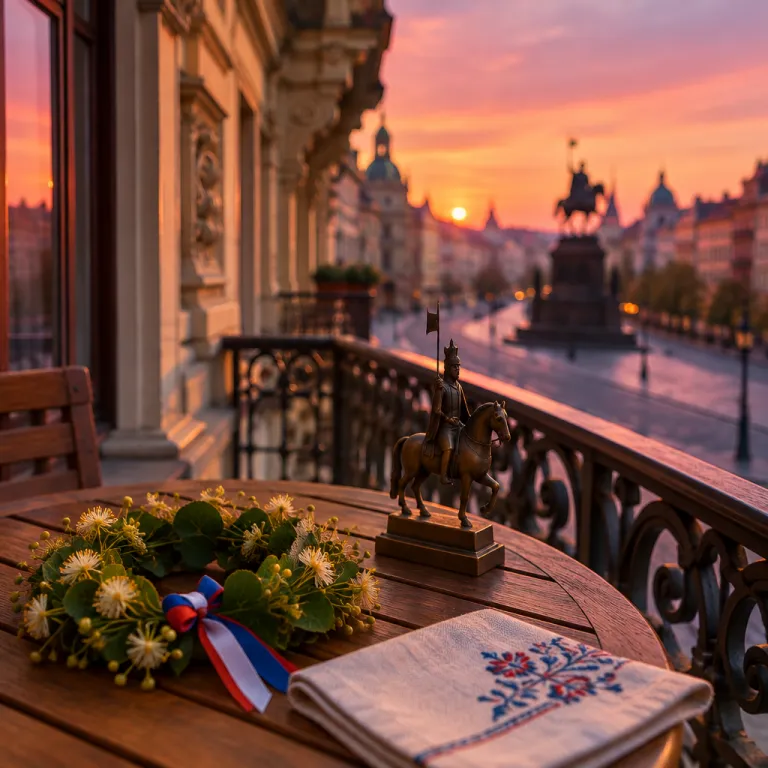
Saint Wenceslas Day and the quiet heart of Czech statehood
Saint Wenceslas Day, the Czech statehood holiday, is a still point in a busy travel calendar. On this national holiday the day Czech rhythm slows, and the country turns inward rather than staging loud spectacle. For a solo traveller, that quieter mood can feel like a private audience with the Czech Republic itself.
The story behind saint Wenceslas Day, Czech statehood holiday observances begins with Václav, the young duke of Bohemia who later became known as king Wenceslas in legend. Historically he ruled as a duke of Bohemia rather than a crowned king, yet the image of a good king guiding his people shaped the national imagination. That tension between modest historical rank and elevated memory says much about how the modern republic understands its own scale and dignity.
Across the Czech Republic the date in late September is marked by church services, wreath layings and moments of silence rather than parades. The feast day is dedicated to saint Wenceslas as patron saint of the land, and the focus stays on reflection, continuity and gratitude. This is why the saint Wenceslas Day, Czech statehood holiday atmosphere suits travellers who prefer meaning over noise.
In Prague the statue of saint Wenceslas on horseback dominates Wenceslas Square, facing up the long boulevard that has witnessed protests, revolutions and quiet vigils. Locals simply say “under the horse” when arranging to meet here, proof that the patron saint has slipped from legend into everyday language. Standing on this square Prague reveals how a medieval duke of Bohemia still anchors a very contemporary sense of Czech statehood.
While many visitors rush past on their way to Old Town, the square Prague axis from the National Museum down to Můstek is a timeline of the republic in stone and glass. On saint Wenceslas Day, Czech statehood holiday ceremonies often cluster near this space, yet the mood remains calm and open to respectful outsiders. You can watch families lay flowers at the base of the monument, a small gesture that keeps the legend alive.
The wider landscape of Bohemia also participates in this national holiday, though in more understated ways. In smaller towns the holiday Czech rhythm might mean closed offices, fuller churches and longer lunches at family tables. For travellers, that slower pace invites you to read the country through its silences as much as its castles and squares.
From duke of Bohemia to patron saint: the legend behind the day
To understand saint Wenceslas Day, Czech statehood holiday traditions, you need the outline of the legend. Wenceslas, or Václav, ruled as a Christian duke of Bohemia in a landscape still negotiating older beliefs. His grandmother Ludmila, later venerated among Czech saints, had raised him in the new faith and shaped his reputation for being a good ruler.
The family story is anything but simple, and that complexity echoes through the Czech Republic’s sense of itself. Ludmila was murdered in a power struggle, and Wenceslas’s mother Drahomíra is often cast in the legend as her rival, a reminder that even saintly narratives have sharp political edges. When Wenceslas was later killed near Stará Boleslav, allegedly on the orders of his brother Boleslav, the drama fixed him forever as a martyr duke.
Over time this duke of Bohemia became king Wenceslas in the popular imagination, especially outside the Czech lands. The English language Christmas carol “Good King Wenceslas” turned him into a winter figure, though the real feast day falls in September. That carol, good as it is for melody, has probably confused more than one traveller arriving in Prague expecting snow and Christmas markets.
Yet the Christmas carol also helped export the idea of a good king who cares for the poor, which resonates with how Czechs talk about social fairness today. When you hear the phrase good king Wenceslas in English, you are touching a very old bridge between Bohemia and the wider world. The carol “Good King Wenceslas” may be sentimental, but it keeps the patron saint’s name circulating far beyond Wenceslas Square.
Back in Prague the historical Wenceslas is woven into the stones of Prague Castle and the spiritual life of St Vitus Cathedral. His relics rest in the richly decorated Saint Wenceslas Chapel, a small, jewel toned space that feels almost private even on busy days. Visiting this chapel on the saint Wenceslas Day, Czech statehood holiday brings the story full circle, from legend and carol to a very real room of prayer.
Architecture across Bohemia quietly references this heritage, and luxury properties have started to draw on it with more confidence. High end hotels near Prague Castle or around square Prague often echo the colours and motifs of medieval saints in contemporary ways. For travellers who care about design, this is where heritage stops being a museum piece and becomes part of your nightly surroundings.
One of the most rewarding ways to explore this intersection of story and space is to stay in a property that understands the city’s layers. Our guide to a more nuanced Bohemian Baroque in Prague’s lesser known palaces shows how some addresses translate history into texture, light and proportion. Reading it before you book helps you choose a room that feels aligned with the saint Wenceslas narrative rather than just near the sights.
How the national holiday feels on the ground in Prague
On the saint Wenceslas Day, Czech statehood holiday, Prague wakes up differently. Offices stay closed, trams run a quieter pattern and the usual commuter rush around Wenceslas Square softens into a slower flow of families and small groups. For a solo traveller this shift in tempo can feel like the city has taken a deep breath.
The national holiday is marked by religious services, official commemorations and informal gatherings rather than large public festivals. At St Vitus Cathedral within Prague Castle, the liturgy for the patron saint draws clergy, politicians and ordinary worshippers into the same vaulted space. You may not understand every word, but the choreography of incense, organ and procession communicates a shared respect for the country’s roots.
Outside, the courtyards of Prague Castle often feel less hurried than on a regular day, because many visitors are locals who know exactly why they are there. Looking down from the ramparts you see a city that has survived empires, occupations and revolutions, yet still pauses each September to honour a medieval duke. That continuity is the quiet message of saint Wenceslas Day, Czech statehood holiday observances.
Down the hill, Wenceslas Square becomes a barometer of the republic’s mood. This long square Prague axis has seen tanks, demonstrations and candlelit vigils, and on this day Wenceslas himself presides over a more introspective scene. People leave flowers, stand in small clusters or simply sit on benches watching the flow of the day Wenceslas has come to symbolise.
Luxury travellers often ask whether they should avoid the city on a holiday Czech date, worried about closures. In practice, many high end hotels, restaurants and cafés remain open, though some museums adjust hours, so the city feels pleasantly uncrowded rather than shut down. It is a good moment to lean into a slower schedule, with one major site, one long lunch and one evening walk rather than a checklist.
Design forward hotels near the centre often respond to the saint Wenceslas theme with subtle gestures rather than overt branding. You might notice a curated library corner with volumes on Bohemia, a lobby artwork referencing a medieval carol, or a view line that frames Prague Castle and St Vitus Cathedral at dusk. These touches matter because they align your private space with the public story unfolding outside.
If you are planning a premium stay around this national holiday, it is worth understanding how different properties handle heritage. Our detailed guide on booking a premium suite in Prague and navigating luxury hotel experiences explains which addresses lean into Czech statehood narratives and which prioritise international gloss. Matching your expectations to a hotel’s design philosophy will shape how you experience saint Wenceslas Day, Czech statehood holiday moments.
Beyond Prague, exhibitions and cultural projects across the Czech Republic often use the reflective mood of late September to explore history in new ways. One example is the Slavkov château near Austerlitz, where projects like the Slavkov exhibition on Napoleon and Austerlitz show how technology can animate the past without trivialising it. That same balance of innovation and respect is what you should look for in hotel design that references saint Wenceslas and Czech statehood.
Design inspirations from Czech heritage for luxury stays
For a traveller choosing a luxury hotel, saint Wenceslas Day, Czech statehood holiday themes are not just background history. They are a design language that runs from the mosaics of St Vitus Cathedral to the restrained façades of First Republic town houses. The most interesting properties translate that language into contemporary interiors without slipping into costume drama.
Start with colour and material, because this is where Bohemia speaks most clearly. Deep reds and blues echo the Saint Wenceslas Chapel, while polished stone and dark woods recall the corridors of Prague Castle and the cloisters where medieval saints were once venerated. When a lobby or suite uses these tones with restraint, it feels like a quiet nod to the patron saint rather than a themed set.
Iconography can be trickier, especially when dealing with religious figures such as saint Wenceslas, Ludmila or other Czech saints. The most sophisticated hotels avoid literal statues of a good king or overt reproductions of Christmas carol illustrations, choosing instead abstracted motifs, heraldic patterns or contemporary art that references the legend. This approach respects both the faith dimension of the feast day and the secular comfort of international guests.
Location also shapes how heritage feels in practice. A property near Wenceslas Square might lean into the urban story of protests, the Velvet Revolution and the evolving identity of the republic, while a retreat closer to Stará Boleslav or other corners of Bohemia could reference pilgrimage routes and rural chapels. In both cases, the saint Wenceslas Day, Czech statehood holiday narrative becomes a lens for understanding the surrounding streets.
Some of the most compelling design inspirations come from the tension between public and private ritual. On the one hand you have the formal liturgy at St Vitus Cathedral and the official speeches about Czech statehood, on the other the intimate gestures of families lighting candles or singing a carol good enough to pass down generations. Hotels that create small, contemplative spaces — a reading room, a courtyard, a window seat facing Prague’s roofs — echo that duality.
Even details like room naming can carry meaning when handled with care. Suites named after Bohemian towns such as Stará Boleslav or after figures like Ludmila and Drahomíra can gently introduce guests to the cast of the legend without turning the corridor into a history lesson. When you return from a day tracing Wenceslas Day sites, opening a door with such a name feels like stepping back into the story.
For solo travellers, these design cues offer orientation as much as aesthetics. They help you connect the saint Wenceslas Day, Czech statehood holiday you see in streets and churches with the quieter world of your room, where a well chosen book on Bohemia or a photograph of Prague Castle at dawn can prompt reflection. In a country that values understatement, this is how luxury and heritage speak the same language.
Planning a reflective luxury stay around Saint Wenceslas Day
Choosing to be in the Czech Republic for saint Wenceslas Day, Czech statehood holiday observances is a deliberate act. You are opting for a national holiday defined by reflection rather than fireworks, and that choice should shape how you plan your stay. Think in terms of depth, not volume.
Begin with geography, because where you sleep will frame how you experience the day. Staying near Prague Castle or within walking distance of St Vitus Cathedral places you close to the liturgical heart of the feast day and the architectural core of Czech statehood. A base near Wenceslas Square, by contrast, immerses you in the civic story of the republic, from student protests to quiet vigils under the equestrian statue.
Solo travellers often benefit from hotels that balance discretion with strong concierge teams. On a holiday Czech date like this, a well briefed concierge can advise which services are open, how to time a visit to the Saint Wenceslas Chapel or where to find a calm café after the liturgy. That human guidance matters more than usual when the city’s rhythm is slightly altered.
Consider structuring your saint Wenceslas Day, Czech statehood holiday around three anchor points. Morning at Prague Castle and St Vitus Cathedral connects you to the spiritual and dynastic story of Bohemia, midday around Wenceslas Square links you to the modern republic, and late afternoon in a quieter neighbourhood lets you absorb what you have seen. This simple arc turns the day Wenceslas is honoured into a coherent narrative rather than a series of disconnected sights.
Evening is when the city’s reflective mood settles in, and your hotel becomes central again. A property with a well curated bar or lounge — somewhere you can sit with a glass of Moravian wine, looking towards the castle or over square Prague rooftops — extends the contemplative tone of the national holiday. You are not just ending a day of sightseeing, you are participating in how Czechs carry their history into the night.
For many guests, the most moving moment comes not from official ceremonies but from small, unscripted scenes. A family explaining the legend of saint Wenceslas to a child near the statue, a group of friends quietly singing a fragment of a Christmas carol on a tram, a candle flickering in a side chapel dedicated to Ludmila or other saints. These glimpses reveal how a small nation holds its past close without turning it into spectacle.
When you leave, the saint Wenceslas Day, Czech statehood holiday will likely stay with you as a texture rather than a single image. You will remember the way the word “king” is used for a duke of Bohemia in song, the way the republic honours a patron saint in a largely secular age, and the way luxury hotels weave these threads into their design without shouting. That is how Czechs see themselves — modest, historically aware, and quietly proud — and why this understated holiday is worth building a trip around.
FAQ
Is anything open in Prague on Saint Wenceslas Day ?
On saint Wenceslas Day, Czech statehood holiday schedules shift, but the city does not close. Most luxury hotels, many restaurants and a good number of museums remain open, though some operate reduced hours. Public transport runs, so you can still move easily between Prague Castle, Wenceslas Square and other key sites.
Where should I stay in Prague for Saint Wenceslas Day ?
If you want to focus on the spiritual side of the feast day, choose a hotel within easy reach of Prague Castle and St Vitus Cathedral. Travellers more interested in the civic story of the republic might prefer a base near Wenceslas Square or in the New Town. Both areas offer a strong selection of luxury and premium properties with thoughtful design.
Is Saint Wenceslas Day a good time for a first visit to the Czech Republic ?
Yes, saint Wenceslas Day, Czech statehood holiday observances offer a clear window into how Czechs understand their history. The atmosphere is calm, crowds are thinner than in peak summer and the late September light is often beautiful. It suits travellers who value culture, architecture and reflective city walks over big events.
Do I need to attend religious services to appreciate the holiday ?
You do not need to attend mass to understand the meaning of the day, though a short visit to St Vitus Cathedral or another church can be illuminating. Simply observing how people behave around the statue on Wenceslas Square or in the courtyards of Prague Castle already tells you a lot. Respectful presence is enough.
How far is Stará Boleslav from Prague, and is it worth visiting ?
Stará Boleslav, associated with the death of saint Wenceslas, lies roughly 25 kilometres northeast of Prague. It is an easy half day trip by car or public transport and offers a quieter, more intimate perspective on the legend than the capital. For travellers interested in Czech statehood and religious history, it is a rewarding complement to time spent at Prague Castle and Wenceslas Square.
Sources
Czech National Museum ; Prague Castle Administration ; Archdiocese of Prague.